
BIOSECURE Turns Supplier Dependence Into an Evidence Question
DEICELL SYSTEMS | REGULATORY EXPLAINER
July 7, 2026
BIOSECURE Makes Supplier Dependence a Readiness Test
BIOSECURE pressure reaches beyond procurement teams by forcing biotech, medtech, CDMO, CRO, supplier, quality, regulatory, and diligence teams to prove how supplier choices, outsourced work, contract chains, and change-control paths are understood.
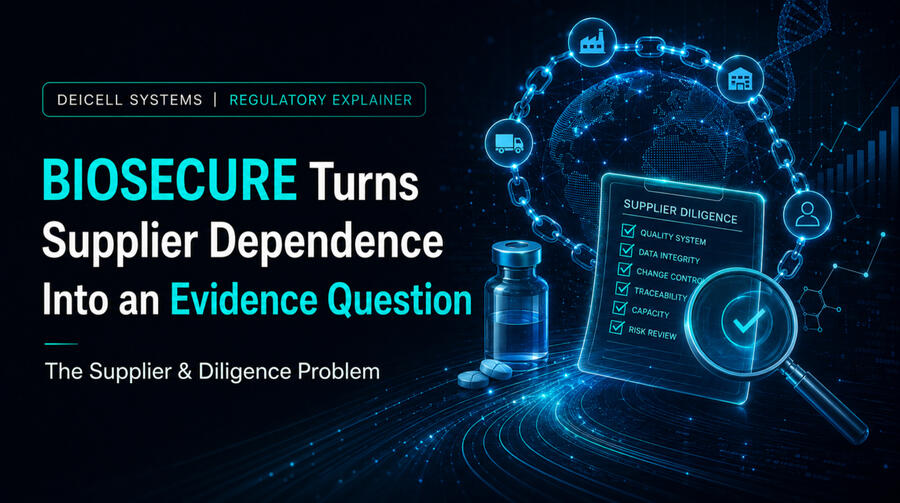
A supplier decision that once looked like a technical fit or capacity decision can become a reviewable operating record. Under the introduced H.R. 7085 BIOSECURE Act text, federal agencies would be restricted from procuring covered biotechnology equipment or services from a biotechnology company of concern and from contracting with entities that use those covered services or equipment in performance of a federal contract. The bill also addresses loan and grant funds.
For operating teams, the pressure sits in the supplier file, the quality agreement, the subcontractor record, the data pathway, and the change-control rationale. BIOSECURE asks whether the company can show where biotechnology equipment, services, biological-material data, manufacturing support, analytical work, and outsourced execution actually sit inside the supplier network.
KEY SIGNALS
- Supplier selection is becoming a documented risk decision: H.R. 7085 defines biotechnology equipment and services broadly, including genetic sequencers, mass spectrometers, PCR machines, components, accessories, software, firmware, data storage, data transmission, research, development, production, analysis, detection, consulting, support, and related services tied to biological materials.
- Contract-chain exposure matters: The introduced bill language addresses direct use of covered biotechnology equipment or services and contracts whose performance would require direct use of such equipment or services after the applicable effective date.
- The response is supplier evidence, not supplier panic: The GRxBiosims BIOSECURE deck identifies practical company actions such as representations and warranties, equipment and contract due diligence, CMO diligence, supplier diversification, and understanding wind-down or transition timing.
THE REGULATORY ISSUE
BIOSECURE was presented through a national-security and privacy frame, but its operating mechanism is procurement control. The GRxBiosims legal overview notes that supporters viewed the legislation primarily as a national-security and privacy law, while the bill moved through government-wide contracting committees rather than FDA or biomedical research committees.
That mechanism changes the practical burden for regulated and pre-commercial teams. The question is no longer limited to whether a supplier can perform the work. The question becomes whether the company can defend the supplier relationship when a federal customer, grant pathway, contracting clause, investor, acquirer, or diligence reviewer asks how the dependency was evaluated.
The introduced H.R. 7085 text defines a biotechnology company of concern to include named entities and entities subject to the jurisdiction, direction, or control of a foreign adversary that are involved in biotechnology equipment or services and pose specified national-security risks, including military or intelligence affiliations, multiomic-data transfer, or obtaining human multiomic data without express and informed consent.
WHY THIS SHOWS UP AS AN OPERATING ISSUE
Supplier decisions are often made early, when the company is optimizing for speed, technical access, available capacity, or runway. Those decisions can later become embedded in assay development, cell-line development, analytical methods, device testing, process development, API supply, clinical supply, software workflows, and regulatory narratives.
The weakness appears when the company has to explain the dependency after the decision has already shaped the program. A team may know that a provider was useful. It may not have a current record showing what the provider touches, what data moves through the provider, which subcontractors or affiliates are involved, which records the provider holds, and what would happen if the relationship had to change.
BIOSECURE makes that gap more visible because the restriction logic is tied to equipment, services, direct use, contract performance, grants, loans, and supplier relationships that can sit several layers away from the sponsor. The GRxBiosims deck’s supply-chain hypothetical traces concern through a biotechnology company of concern, a starting material supplier, an API manufacturer, a finished-dose manufacturer, a U.S. drug company, and a federal-government customer.
THE OPERATING GAP
Outsourcing is normal in biotech and medtech development. The gap appears when the supplier relationship becomes embedded in product quality, process knowledge, biological-material data, regulatory records, or delivery capacity without a documented owner and transition path.
A supplier file may show that a vendor was approved. That is not the same as showing why the supplier was selected, what role the supplier plays, what records or data the supplier controls, whether the supplier relies on restricted subcontractors, what alternatives exist, and what change-control route would be required to replace the provider.
For quality teams, the pressure lands in supplier qualification, approved supplier list logic, quality agreements, subcontractor controls, audit records, representations and warranties, and change triggers. For regulatory teams, it lands in CMC assumptions, design history, analytical method continuity, validation evidence, comparability, and transfer records. For diligence teams, it lands in whether the company can explain supplier exposure without reconstructing the supply chain under transaction pressure.
WHAT THIS MEANS FOR TEAMS
Biotech and medtech sponsors need supplier-selection rationale that can survive more than internal memory. A development-stage company may have a valid reason for choosing a specific provider, but that reason should be recorded while the decision is current. Reconstructed rationale is weaker when a financing, federal opportunity, acquisition review, or regulatory discussion depends on it.
CDMOs and CROs should expect sponsors to ask more specific questions about equipment, subcontractors, affiliates, data systems, and biological-material workflows. A provider that can answer with controlled records will be easier to defend than one that relies on informal assurances.
Suppliers should understand the provenance of components, software, instruments, subcontracted services, and data infrastructure used to generate, process, store, transmit, or analyze biological-material information. BIOSECURE pressure can attach to the tools and services behind the delivered work, not just the final deliverable.
Quality and regulatory leaders should classify exposure before they expand controls. The practical task is to identify which suppliers touch product quality, biological data, regulated records, clinical supply, manufacturing knowledge, analytical validity, or federal contracting pathways. Some relationships may need monitoring. Some may need contract language. Some may need a transition plan. Some may remain acceptable at the current stage with a clear rationale.
READINESS CHECK
- Can the team show a current supplier map identifying which vendors, CROs, CDMOs, laboratories, software providers, equipment platforms, subcontractors, and affiliates touch biological materials, product quality, regulated records, data storage, data transmission, analytical work, manufacturing execution, or federal contracting pathways?
- Can the team show why each high-impact supplier was selected, what alternatives were considered, who approved the decision, and which risk assumptions were accepted?
- Can the team show whether a provider uses biotechnology equipment or services that could create federal-contract, grant, loan, customer-certification, or diligence exposure?
- Can the team show supplier qualification records, quality agreements, subcontractor controls, audit history, and representations or warranties that match the supplier’s actual role?
- Can the team show a change-control path for replacing a supplier, including transfer assumptions, validation impact, comparability needs, regulatory impact, record migration, training, and timeline risk?
- Can the team explain which dependencies are acceptable for the current stage, which need monitoring, and which require action before the next financing, clinical milestone, federal opportunity, or commercial commitment?
DEICELL VIEW
BIOSECURE should push early-stage teams toward clearer supplier records, not larger supplier systems.
The strongest operating response is a current supplier map, assigned ownership, risk-based classification, documented selection rationale, and a controlled transition path. That is different from building an enterprise procurement program before the company needs one.
For pre-commercial and early-clinical teams, the readiness test is whether supplier decisions can be defended without slowing execution or overbuilding the QMS. A company does not need a large procurement department to answer BIOSECURE-driven questions. It does need enough structure to show who owns supplier decisions, how dependencies are reviewed, what records support the decision, and how the organization would respond if a supplier became restricted, challenged, or commercially untenable.
DeiCell’s view is that BIOSECURE turns supplier management into a diligence-facing control. The teams best positioned for this pressure will be the ones that can show why their supplier network fits the current stage and how it can change without losing control of quality, validation, traceability, or execution.
DISCUSS AN OPERATIONAL GAP
If BIOSECURE raises questions about supplier dependence, outsourced execution, quality-system records, or change-control readiness, DeiCell Systems can help evaluate where the operating gap sits and what evidence should exist at the current stage.
The goal is not to overbuild supplier control. The goal is to make supplier decisions clear enough to withstand quality review, regulatory discussion, federal contracting pressure, and diligence.

AUTHOR / CONTACT
Nathan Jones
Founder & Principal Consultant, DeiCell Systems




For a practical review of this issue, contact DeiCell directly or connect with Nathan Jones on LinkedIn.